
SmartWorkbench — trust the work you hand over, and check it
A Claude Code mod that lets you check the work with your own eyes instead of taking "it's done" on trust. It locks the goal and the done conditions, asks about or blocks risky commands, and lets you watch what Claude does as it happens.
The moments when you still feel uneasy
Handing work to Claude Code brings moments like these: as the conversation grows, Claude quietly forgets a condition you set at the start; it says the tests pass, but it edited the code again afterwards; you tense up each time in case a git push --force or rm -r slips through; and the next day you cannot remember where you left off. SmartWorkbench was built to solve these four inside Claude Code.
It pins the goal down
At the start you write the goal, constraints, non-goals and done conditions and lock them; from then on that contract rides along with every request as context only Claude reads. However long the conversation gets, the original agreement does not fade.
You can pin important files and notes, down to a line range such as src/auth.ts:10-40, and a preview shows exactly what Claude will receive. A done condition such as "related tests pass" is linked to the matching kind of check from its wording.
It asks about or blocks risky commands
Every tool call gets a risk level. Reading passes; sending things outside, such as git push or a deploy, and commands that could expose secrets, such as reading .env, are asked about first; hard-to-undo commands such as push --force, reset --hard and rm -r are blocked in the default setting.
You pick the strictness — high, medium, low or off — and a rules file in the repository lets the whole team share the same rules. That file can only make the rules stricter, so the built-in blocks cannot be loosened by accident.
Evidence, not "it's done"
There is one core principle: Claude's words alone never make a task done. Only checks such as tests, builds and type checks that finish without error count as evidence, and if code changes after a check passed, that condition drops back to "needs re-check".
Each file shows whether a check ran after its last edit, and a task becomes complete only when every done condition is verified or explicitly waived by a person.
Team mode: splitting the work between models
Turn on team mode and the roles split: Opus designs and reviews, Sonnet builds, Haiku explores. A design is asked for before a big edit, Opus is consulted when the same command fails twice, and a turn that changed code is held once for a check before it ends.
Codex can be added as a second opinion, but it is off by default. When on, Codex sends the changes and the files it reads to OpenAI, so you are asked for consent before it is turned on.
Watching it live
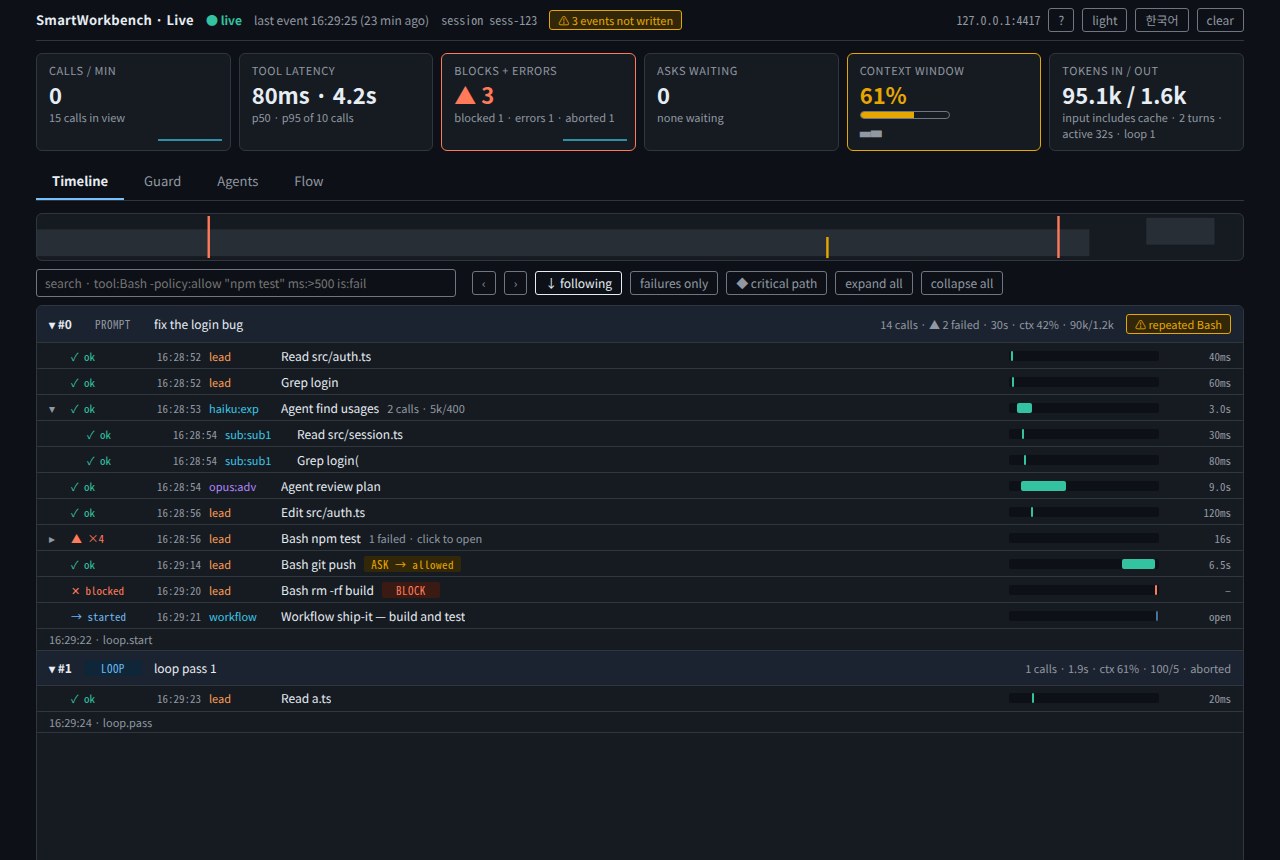
In a browser you follow requests, tool calls (with masked input and results), guard decisions, subagents, and token and context use in time order. Sessions that use the same port appear as one tab each on one page, and through a reverse proxy it can be opened from a phone. By default the server is reachable only from this computer.
Recording why a change was made
A commit records what changed, not why. Turn on the decision ledger and it keeps the request and decisions behind each change, so /swb why file:line can tell you why a line is the way it is. It is off by default, sharing with a team happens only when you publish a session yourself, one at a time, and tool input and output are never published.
A desktop app (a notification tray) is being built alongside but has not been checked yet, and since the mod runs on an early-access extension feature of Claude Code, it may change in later versions.
Install
At the Claude Code prompt, one line is enough. When asked whether to add the marketplace, answer y and choose the user scope.
/plugin install smartworkbench --marketplace nathak/smart-workbench
Key features
Source and usage
The full command list, guard rules and team mode settings are in the repository README.